
Understanding issues#
BIDS Validator issues are structured results that describe problems or potential problems in the dataset. Issues can either be warnings or errors.
Errors are emitted when a violation of the BIDS specification is detected, or, in some cases, the validator is unable to read part of the dataset. Errors must be resolved in order for a dataset to be considered valid.
Warnings are emitted when BIDS specification recommendations are not followed, as well as cases where a common problem may be present, and user attention is needed to verify the validity of the dataset.
Issue model#
Every issue has a code indicating the issue type, a location indicating the file where the issue was detected, and a severity field that can either be “warning” or “error”. If some issues are configured to be ignored, in JSON output mode they would still be listed and have severity “ignore”.
|
|
|
|---|---|---|
|
|
|
|
|
|
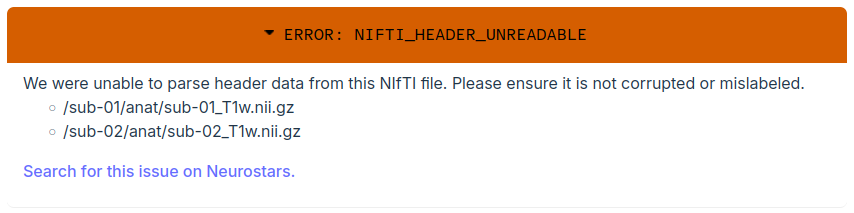
In the web validator, these issues appear as:



In the command-line validator, these would be rendered as:
	[WARNING] README_FILE_SMALL The recommended file '/README' is very small.
    Please consider expanding it with additional information about the dataset.

		/README

	[ERROR] NIFTI_HEADER_UNREADABLE We were unable to parse header data from this NIfTI file.
    Please ensure it is not corrupted or mislabeled.
		/sub-01/anat/sub-01_T1w.nii.gz
		/sub-02/anat/sub-02_T1w.nii.gz
Subcodes#
Some classes of issue can be found many times, even in the same file.
For example, invalid sidecar metadata,
such as using "MagneticFieldStrength": "3T" instead of "MagneticFieldStrength": 3,
triggers a JSON_SCHEMA_VALIDATION_ERROR because the value must be numeric rather
than textual.
Consider the following issues:
|
|
|
|
|---|---|---|---|
|
|
|
|
|
|
|
|
|
|
|
|
|
|
|
|
|
|
|
|
Each of these issue codes are general, and the subcode indicates the specific JSON field that is missing or invalid.
Note that, when a value is absent or invalid in a specific file,
the location is the JSON file can be listed.
For example, the invalid MagneticFieldStrength may affect many *_T1w.nii.gz files,
but it can be found in a single file.
On the other hand, for missing sidecar keys, the inheritance principle
permits the data to be defined in multiple files.
All fields#
The validator defines the following fields for issues:
Field |
Type |
Description |
|---|---|---|
|
|
The type of issue detected |
|
|
For some |
|
|
|
|
|
A path to the file in the dataset where the error occurs. |
|
|
A human-readable description of the issue. |
|
|
A suggestion for a plausible fix. |
|
|
A list of files affected by the error, if more than |
|
|
The rule ID in the BIDS schema that failed to pass. |
|
|
The line number (0-indexed) in |
|
|
The character column (0-indexed) in |
All fields except code, severity and location are optional and may be
absent from any issue.
External validators#
BIDS reuses many other data standards (see e.g. BIDS Philosophy section). Where feasible, the BIDS Validator will call an external validator and expose its issues as BIDS issues.
Hierarchical Event Descriptors (HED)#
The HED validator produces issues of the following form:
Field |
Type |
Description |
|---|---|---|
|
|
|
|
|
The |
|
|
|
|
|
A path to the file in the dataset where the error occurs. |
|
|
A human-readable description of the issue. |
|
|
The line number (0-indexed) in |